After making big inroads into the Australian passenger car market, Chinese manufacturers have launched their offensive to claim the last bastion of ‘Aussie’ motoring – the ute market.
One of the big players is GWM with its Cannon range, including the top-shelf Alpha Ultra, with plug-in hybrid (PHEV) capability.
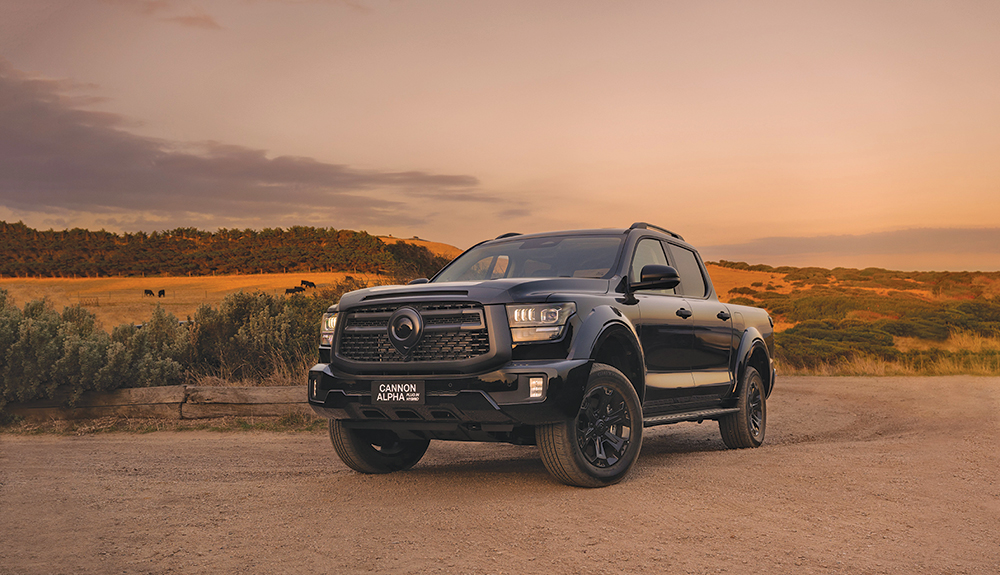
The Cannon is big and boxy, there is no pretence of style or form, it is all function, including a flat nose, slab sides and squared-off cabin.
Flared guards push the front and rear track wide, not just stabilising the car’s footprint but adding a more purposeful look to the Cannon.
No shrinking violet, at 5.4 metres bumper to bumper, a touch under two metres wide and 1.92 metres tall – I couldn’t see over the roof! – GWM is clearly stating its intentions.
The cabin dominates these figures, without putting a tape measure on it, I can say this is one of the roomiest cabs on the market.
Bonus points for wide-opening doors, unless you are in a crowded shopping centre car park – you know the one – in which case you go for the remotest, quietest corner of the building.
Less-longlegged occupants (can’t say short!) will appreciate the standard side steps, they don’t need a parachute, but it is a long way down, contributing to the 800mm wading depth.
One area that needs attention on the PHEV is the location of the battery pack, sitting under the tray it takes the spare wheel’s space from the ICE models, resulting in an industrial-looking bracket bolted to the right rear of the tub with the spare standing vertically, eating into the load space.
While 18” alloys are standard, the spare is a painted steel rim, given its location, investing in good anti-theft nuts will help keep it there.
The Ultra has a 60-40 split tailgate, the left section swings open, you can stand at the bumper to load and unload, convenient for us ‘normals’ and the greatest thing since the bread slicer for the less reach-enabled.
Dropping the full tailgate allows bulk loads like soil to be unloaded as usual, climbing in to apply the shovel.
The overall impression is North American, with dimensions that go close, the influences are easily seen.
Fun fact – look at the front and rear emblems sideways, and with a little imagination, you will see a cannon…
As expected from the exterior, the inside is roomy, travelling with my equally wide-shouldered son, we revelled in the available space.
Seats were broad and supportive, front and rear, even with the grandkids in their baby seats, there was still plenty of legroom.
Not only are the leather-accented front seats powered, they include an effective massage function, along with heating and cooling.
The rears are equally equipped, the outboard seats are heated and cooled, with powered fore and aft adjustment, translating into a ‘welcome’ function, sliding rearwards for more entry and exit space.
Pet peeve: Please GWM, can we have height adjustable seatbelt mounts on the B-Pillar? I can raise the front seats, but that reduces my ability to see the instrument cluster, even with the height and reach adjustable steering column.
While the accommodations are spacious and the centre stack is easily accessed, including dual zone automatic climate control, the big infotainment screen is a mixed blessing.
Standard with AM/FM/Apple and Android, it dominates the space, but adjusting the display brightness is a challenge, despite accessing the vehicle settings menu, including for the cabin ambient lighting, there was not a brightness control.
The result was a retina-burning glare in the centre of the car, reflected in the windows, not helping my night vision.
Thankfully the heads-up display was easily read, projecting above the bonnet line, although like most, it doesn’t fare well against polarising sunglasses in daylight.
Other clever touches include a sliding rear window, although it is more like a ski-port, but it allows additional low-pressure ventilation, as well as a panoramic sunroof that doesn’t impact headroom excessively.
Power for the Cannon comes from a 2-litre, four cylinder, turbocharged petrol engine mated to a 120kW electric motor, with maximum outputs of 300kW and 750Nm.
This eyewatering output goes to ground through a nine-speed automatic transmission with the options of 2H/4H/4L, depending on the terrain.
GWM included front and rear diff locks to make the Cannon Ultra a genuine off-road contender, the standard 18” alloys open the door to a range of aggressive tyre options.
Right up to the moment I drove it, I was impressed by the Cannon, it is big and bold, making a powerful statement.
Then I discovered the electronic integration issues we experienced with previous Cannon utes have yet to be resolved.
I support driver assist technologies, I have been rescued from my mistakes on more than one occasion, unfortunately unlike quantifiable tech such as ABS brakes where performance and operation can be set and measured, items including driver monitoring and lane keep assistance are a ‘Yes/No’ fitment, with limited ways to check deployment and efficiency.
The Cannon’s systems are ultra-sensitive and ultra-aggressive in their response, while they can be disabled at engine start, this needs to be done before every drive.
The ‘Emergency Lane Keep’ reactivates when you use the Adaptive Cruise Control, it cannot be deactivated once you are driving.
The result is a car with seemingly a mind of its own, trying to centre the car if it thinks you have strayed too far in the lane.
For an unwary driver, thinking they have control of the car, this sudden twitch of the wheel can be unsettling to say the least.
GWM has started an Australian-led engineering program, ‘AT1’, to reduce these issues, but these cars will not reach our shores until late 2026 or 2027.
All of this is a shame, because these electronic challenges blunt the appeal of an otherwise good car.
Those 300kW, a figure chased by many performance cars, makes the Cannon effortless to drive, with the ability to overtake at will.
Add energy capture that rivals the best in the business, which kept the battery levels well above 50% in more than 750 kilometres of driving, the Cannon is not only sharp, it is frugal.
Offroad, the Cannon shows plenty of promise, yes, the rear is lively when unladen, although the rear-mounted EV battery helps anchor the back end.
Throw in the 3.5 tonne towing capacity and all the ingredients are there for the Cannon to take the battle to the established players.