
The Central Coast is one of New South Wales’ leading regional tourism destinations. Only 45 minutes north of Sydney, the scenic wonderland offers panoramic coastlines, striking nature, hinterland hideaways, and a thriving food scene.
Underpinning these offerings is the region’s growing number of sustainable businesses – one of many reasons the Central Coast was certified as the first ECO Destination in Australia in 2022.
Over two days, I embarked on a journey to uncover natural beauty and incredible food in the Central Coast though a sustainable lens, starting at Noonaweena in Kulnura.
Noonaweena is an eco-friendly sanctuary sitting on 100-acres of land overlooking the valleys of Yengo National Park. It is a green travel leader with 10 years of certification from Eco Tourism Australia.

I spent two nights there; one night in the Glamping Bell Tent and the other in Boronia Cottage.
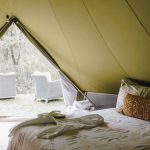
The Bell Tent offers a unique experience – a combination of luxury and nature. Within the tent is three double beds, an assortment of rugs covering the floor, and fairy lights set up on the interior and exterior.
A short stroll away is the kitchen and bathroom. The outdoor kitchen is where I indulged in the provided barbecue hamper and red wine. From there, I sat by the campfire until it dwindled, used the pristine shower facilities, and dozed off to the sounds of crickets and the occasional jumping kangaroo.
The following night, I called Boronia Cottage my home. The cosy self-contained cottage overlooks the National Park and comes equipped with some friendly outdoor housemates – peacocks and chickens! Never in my wildest dreams did I think I would end up sitting on a deck overlooking a stunning landscape with a glass of wine in hand and a peacock at my side, but there I was.

Noonaweena is utterly unforgettable, and it was the perfect base as I explored the region.
My first Central Coast breakfast was at Angel Sussurri Restaurant and Manor House in Yarramalong. It was here that my eyes were first opened to how local people outdo the scenery with how beautiful they are.
I was greeted by Aurora and Deborah, and as Aurora guided me towards the area of the cafe where I could see the most birds, she was able to tell me about the wonderful characters sat at each table and explain the ins-and-outs of the incredible menu.
Here, I dined on the best scones I’ve ever had (probably the best scones ever created) and a pulled pork bagel. That dining experience was only elevated with my knowledge of Angel Sussurri’s sustainability practices.

The family-run business cultivates produce on-site at Rustic Nest, food waste is repurposed, surplus produce is shared with the community, operations are powered by 68 solar panels – and that’s only the half of it!
Matching those sustainability and hospitality standards was my next destination in Holgate: Firescreek Botanical Winery – an award-winning winery that doesn’t use grapes, but instead uses fruits and flowers.
Upon arrival, the winery’s owner Nadia led me to a gazebo overlooking much of the grounds, including ponds filled with lily pads, stunning gardens, and grand trees.
This is where I enjoyed the expertly crafted Chocolate and Wine-Pairing experience, and where I completed the Foraging and Mixology Workshop after a guided tour through the gardens to collect flowers and taste fresh fruits along the way.

A word that Nadia quickly introduced to my vocabulary was ‘permaculture’ – a sustainable approach to land management. The winery embraces that practice with worm hotels, a food forest, and water-saving and regenerative farming.
Sharing that passion for sustainable food cultivation was my final Central Coast stop for the day: Bells at Killcare Boutique Hotel, Restaurant and Spa.
This beautiful restaurant features seasonal dishes inspired by the produce grown and harvested in the kitchen garden.
I embarked on a garden tour with Chef Cam to sample some fresh produce, learn how the menu changes based on local produce availability, and get some menu recommendations. With his advice in mind, I ordered the Sydney rock oysters, the East Coast Yellowfin tuna, Steak tartare, Potato gnocchi, the Grilled grain-fed Flinders Signature rib-eye, and the Tiramisu.

I completed my evening with another walk around the gorgeous grounds before driving back to Noonaweena where I fell asleep excited about the next day’s activities.
Iris Lodge Alpacas was the first destination on my agenda for my final day on the Central Coast.
At the Jilliby farm run by Sean and Sharon – two people with an extraordinary passion for alpacas and the environment – I had the opportunity to meet, feed, pat and get to know the herd.
Guided by Sean, who knew each of the more than 450 animals on the farm by name, this memorable experience was one-of-a-kind.
On the carbon-negative farm, each animal is treated as a pet – not as farm stock – and every visitor to the farm contributes to the destination’s eco-friendly practices, including tree planting and regenerative farming, solar-powered and rainwater harvesting, and composting and recycling. Paddocks are managed using rotational grazing and natural fertilisation, and native trees are preserved to protect local wildlife.

Once you arrive and meet the alpacas, you never want to leave, so it was fortunate for Sean and Sharon that I had another booking to get to.
The cherry on top of my sustainable journey through the Central Coast was Que Sera, Terrigal’s newest wine bar.
The relaxed – but refined – eatery is a welcome addition to Terrigal’s dining scene.
The owner – Sera – explained the menu is inspired by the coast and built around fresh local ingredients.
With her expert advice, I tasted the Sonoma miche alongside the Jamon iberico before diving into the Moonlight oysters, Albacore crudo, Wagyu beef skewers, and the Pork Bianco Ragu.

As with any menu built around seasonal ingredients, everything tasted fresh and energising. With commentary from the lovely Sera throughout the dining experience, I gained a new respect for the food on my plate.
That was actually the case throughout the entirety of my Central Coast retreat. Noonaweena, Angel Sussurri, Firescreek Botanical Winery, Bells at Killcare Boutique Hotel, Restaurant and Spa, Iris Lodge Alpacas, and Que Sera serve as stellar examples of eco-friendly tourism and dining.
They are also incredible examples of hospitality. At each of these venues, I felt connected to the hosts – whether it was a restaurant owner like Aurora and Sera, a winemaker like Nadia, or farmers like Sean and Sharon – you could see the passion for people and place flow from each operator.
A visit to any of these Central Coast destinations will give you a true taste of the region, but I hope for your sake you can visit them all.