

Chaotic, colourful, captivating. This could only be India. “When a man is tired of London, he is tired of life” said Samuel Johnson. However, Samuel never travelled to India.
Aboard our India bound flight there were men in colourful turbans and women in vibrant saris. There were smiles and much head nodding. After a 24-hour journey we unfolded ourselves from the plane and went in search of a taxi. It was after midnight. Our taxi driver dropped us by a dark, sinister alley.
“Too narrow to drive down. You can walk the rest of the way”. What?! At the entrance to the alley a clutch of men stood by the public urinal. Stray dogs gathered. Begrudgingly the taxi-driver agreed to accompany us to the hotel.
The pale light from a nearby shop illuminated paw-prints in the concrete. The dogs began barking. We stopped outside the hotel gates, a sense of dismay. This didn’t look like a 9.2 rated hotel. The dogs barked louder. Finally, the gates opened and Vikram Seth invited us in, and Hotel Jaipur Haveli’s charms came alive.
I’m spending a week in Jaipur with some travel pals, attending the Jaipur Literature Festival, taking in the city’s sights and indulging in some retail temptation.

The Festival is one of the world’s top literature festivals. It was started by William Dalrymple, a Scotsman who eschewed his native Scotland for the warmth and vitality of India. Fittingly we’re welcomed by the sound of bagpipes – played by a magnificently mustachioed gentleman in brilliant regalia. Only in India!
A colourful welcome
Despite knowing few of the writers at the festival chance conversations led to further discoveries. “Who’s that woman over there?” we asked. She had a huge following and even had her own security team. It was Sudha Murty, one of India’s best-selling writers. Standing nearby was her son-in-law, Rishi Sunak.
Britain’s ex-Prime Minister wasn’t getting an iota of the attention that his mother-in-law was. A little later we spotted cooking impresario, Matt Preston. Hard not to. He was wearing an ostentatious checked suit and his signature cravat. He gave us a few restaurant recommendations. Beyond our price range we suspect.
At the Festival we ambled from one venue to the next. Large marquees had been erected in the grounds of Clark’s Hotel. The January/February temperatures were perfect. Joining the ‘Friends of the Festival’ was a bonus. When the cerebral stimulation became too great, we’d decamp to the Friends’ lounge and tuck into refreshing cocktails.

The atmosphere was festive. Indians know how to party. Conversations ensued, photos requested. Invariably the conversation would turn to cricket, bandying names with appropriate expressions. Pat Cummins – thumbs up. Kohli – a reverential nod. Brett Lee – all smiles. Shane Warne – sad face.
Jaipur is known as the Pink City. It was founded by Jai Singh. In 1876, to welcome the Prince of Wales, Jai Singh ordered that the pink sandstone buildings be further ‘pinked up’. The pink has since stayed. Now, in the old town, it’s illegal not to paint the buildings pink. The standard Jaipur pink, actually a terracotta colour, is only available at Government paint stores.
Jai Singh lived in sumptuous style in the City Palace. Today his descendants still occupy the palace, however the public can access a few of the rooms. Nearby is Jantar Mantar. Jai Singh’s fascination with astronomy led to the construction of a series of parks housing gigantic astronomical instruments. Not only are they celestially accurate, they’re architectural delights.
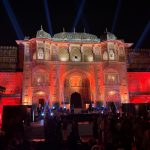
Atop Jaipur’s surrounding hills sits Amber Fort, impressive by day, magical by night. A twilight concert was held in the courtyard. In the surrounding loggia we flopped down on mats and bolsters letting the sweet violin music wash over us. Returning home midst a multitude of mopeds we spotted camels, caparisoned horses and painted elephants. A lone man stood by the road side playing his trombone. Only in India.
No trip to India is complete without enjoying some retail temptations, especially for we three like-minded women! We set off along the dusty streets. Our senses were saturated. In the shops Rajasthani skirts shimmered and semi-precious jewels glistened. Fragrant oud intermingled with cow dung; tooting tuktuks almost obliterated distance calls of the Muezzin. Squirrels shimmied up walls, monkeys dangled from the wiring above and cows sauntered past. Sari vendors unfurled their wares and as we stepped over sleeping dogs and dodged tuktuks and loaded rickshaws, a man beckoned. ‘Come with me to my jewellery shop. It’s just around the corner’. And so we did.
The tiny jewellery shop was a palace of dreams. Rohit tantalised us with rubies, sapphires, emeralds, black diamonds and oh, so much more. He knew the genealogy of each stone, every ring, every earring. Growing up in his grandfather’s atelier, he’d been passionate about stones from age 10. We figured that for every rupee we spent, we saved many more. That afternoon we saved an awful lot of rupees.

After our initial midnight shock, we were charmed with our accommodation. Our rooms were a delight; lead-light windows, ancient doors, marble bathrooms. The beds a tangle of patterned fabrics, cushions and bolsters. The haveli is over 400-years-old. From our roof-top aerie we sipped delicious Indian wine. Above us, monkeys scrambled over the parapets, doves cooed and kids flew kites. We dined in the ground floor courtyard. A pulley system delivered the food three floors up via the atrium. The haveli has been in Vikram’s family for over a hundred years. We met Vikram’s wife, father, children, and Jimmy the dog. At dinner we’d chat to other guests. But one thing is missing, it’s reliable WiFi. We ask Vikram what the problem was. The monkeys ate the wires. Only in India.
Too soon it was our last day in India. A final wander around the shops.
Shopkeepers flaunted fine pashminas, glittering saris and clinquant slippers. A man approached us, insisting ‘Come to my jewellery shop. It’s just around the corner’.
Shades of déjà vu. We trailed him through streets lined with clothing shops, fabrics and jewellers’ equipment, eventually coming to the very same shop we visited on day one. Remarkable! Yet again we succumbed to temptation. Yet again we saved many rupees!
As we departed for the airport the haveli staff farewelled us. They’d become our friends. We could well understand the 9.2 rating.
Our tuktuk driver awaited us, swapping his electric tuktuk for a car. It was sad to leave them, however we’ll be back for Jaipur’s Literature Festival in 2026.